Building Success from the Ground Up: Embracing the bottom-up data strategy
Introduction: Why a bottom-up approach
Introduction: Why a bottom-up approach
When I was first asked to create a data strategy, it looked easy, just set a dot on the horizon and the whole organisation changes direction. This works, with unlimited budget and resources or when special circumstances demand, however, when you have neither, you need to get creative and pragmatic. For any idea to succeed, like a strategy, we need to understand what a data strategy is, what are the options, and which one is the best for you.
A data strategy is a plan that defines how an organisation collects, stores, manages and uses data to drive business value. Data strategy on its own will not lead to success, you need business strategy and IT strategy to support it. Businesses are the sponsors and IT facilitators for the data strategy implementation; hence everyone should be aligned. Failure to do so will lead to setbacks which can hamper the overall goal. You can have the best data strategy, but if it does not align with the business strategy and the IT strategy, then it is bound to fail. Hence it is important that IT strategy, data strategy and business strategy are all aligned.
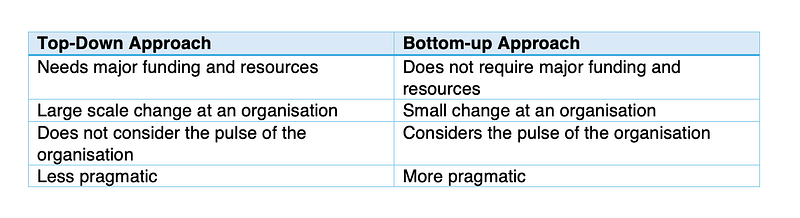
Data strategy can be created by approaching it using the top-down approach or using the bottom-up approach. The top-down approach generally requires large scale changes to an organisation and often does not consider where the organisation is heading. Whereas bottom-up strategy is more pragmatic and help set realistic goals based upon what can be achieved. Bottom-up can help organisation to build a more scalable strategy without undertaking large scale changes.
Understanding bottom-up data strategy
Bottom-up data strategy involves understanding the pulse of the organisation. Understanding the business and IT strategies and organisation’s direction. It is also important to evidence or realise the current initiatives that are in progress where data is key. Once you understand them you can start thinking about “How can data help” in achieving the set goals. This selfless approach helps data gain acceptability with everyone pulling in the same direction. This is the essence of the bottom-up approach, understanding the pulse and then set achievable goals.
It is equally important to avoid the perception that data is an overhead or hindrance which stops the organisation achieve its goals. The bottom-up approach helps in this regard due to the approach focusing on alignment rather than disruption.
Steps to build a bottom-up data strategy
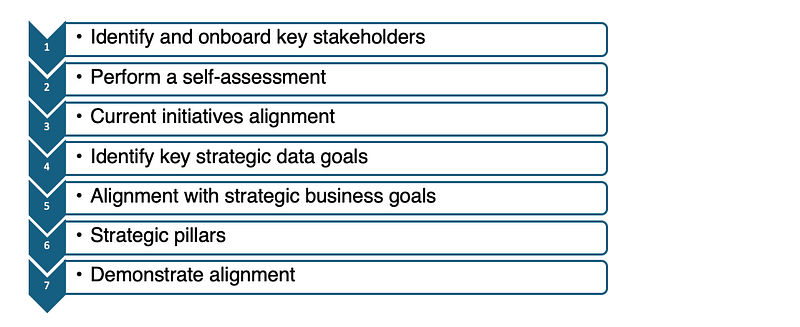
Once you have decided to develop a bottom-up data strategy, it is important to prepare a plan of action. The idea should revolve around, where we are now? where do we want to be? and how do we get there? Once you have set these goals, you need to do the following:
Step 1: Identify and onboard key stakeholders
Identification of key stakeholders is very important as they will be your sponsors and the ambassadors for the change. Consider people who have a stake in data or are facilitators of data. They could be from the business or from IT. Once identified, you need to get them onboard to increase the chance of success.
Step 2: Perform a self-assessment
A self-assessment is very critical to identify the current state of an organisation. This can be either done through questionnaires, interviews or feedback sessions. It is important that we are honest in this assessment as the first step towards real change is acceptance of the problem. This also helps to set expectations towards the organisation.
Step 3: Current initiatives alignment
To have an effective bottom-up data strategy, you need to understand the direction in which the organisation is currently heading and where data does play a key role. This will help you establish the current value of data and give you focus areas in the short to medium term. This is one of the most important step as this leads to alignment of goals.
Step 4: Identify key strategic data goals
This is the target which you would like to achieve as an organisation. This should not be department goal, or an individual goal but should be the goal of the entire organisation. Ideally these should be anything between 1–5 to keep them relatable. These should typically address areas such as compliance, innovation, keeping the lights on, etc. These should be high level goals and not specific targets. The targets should be part of a strategic roadmap which should be out of scope while formulating a long-term strategy. Focus should always be on goals and not tooling.
Step 5: Alignment with strategic business goals
Data strategy and business strategy should be complimenting each other. Data should feed business decisions and business typically sponsor data initiatives. During the first year or two, focus should be on alignment, which essentially means to join the journey which the organisation is already set on, mostly driven by business goals. Once data and business are closely aligned, then steering one would automatically align the other. This would avoid large scale disruption and promote gradual alignment of interests.
Step 6: Strategic Pillars
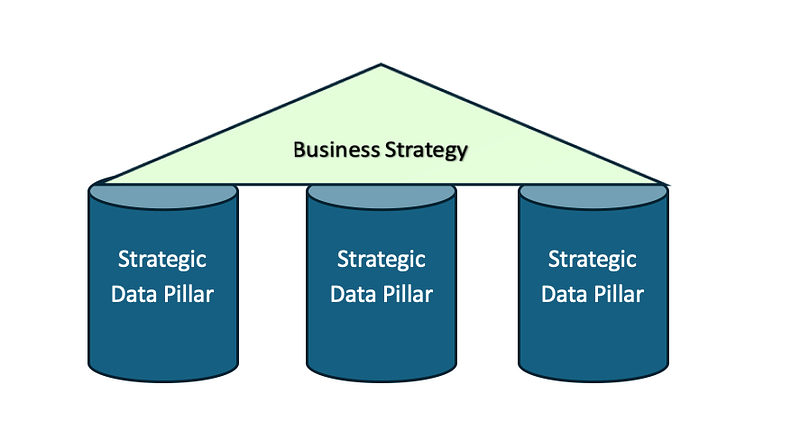
The idea is to base the strategy on a set number of strategic pillars. These are the pillars which will be the foundation of your strategy. The more we work on strengthening the pillars, the closer we get towards achieving our goals. The number of pillars should be finite, somewhere between 2–4, to avoid too many focus areas.
Step 7: Demonstrate alignment
The last step would be to demonstrate how these foundational strategic data pillars would support the business vision and strategy. Do remember that the motto, data is here to help! And this demonstration should help you complete your story. While creating the strategy, always do remember that this is not a roadmap but a strategic document that aligns with the business mission and vision and will assist to achieve business goals.
The usual top-down strategy documentation says a lot and yet says nothing, as it is high level and sometimes far from reality. The biggest advantage of having a bottom-up data strategy is we can clearly demonstrate which data goal will assist which particular business goal and how. This gives a unique advantage during discussions with the rest of the organisation.
A follow up to this strategy document would be a strategic roadmap, which would chart out the next steps with associated timelines.
Challenges & how to overcome them
Like every major change that would require a change in any organisation, there would be potential challenges. However, we can readily mitigate a few of them due to the bottom-up approach:
· Resistance to change: Abrupt pivot is never easy, especially when you speak about changing the culture of any organisation. When nothing works, everyone will readily accept change, however, when everything just works fine, the challenge will be to get everyone onboard who do not think anything needs to be changed. The bottom-up approach tries to mitigate this by not suggesting radical change but joining the journey that the organisation has already embarked upon. This would ensure that data will be seen as an asset and not a liability.
· Conflicting priorities: This is more typical in a top-down approach, as the data priorities may conflict with the business priorities. However, in the bottom-up approach, the initial emphasis is on finding how data can help in achieving business goals which would not lead to such conflicts. In the long term, when business goals and data goals are aligned, we will never have any issue as one feeds the other.
· Lack of (visible) progress: The biggest drawback that any change faces is the lack of visible progress which leads to people losing faith. The bottom-up strategy helps gain trust by following a motto, I win when you win! by aligning with the current business goals, helping business succeed, data would succeed.
· Lack of Sponsorship: Sponsors are critical for the success of any initiative, without them, we cannot succeed. Hence it is critical to get them onboard. The way the bottom-up tries to get them onboard is by aligning with the business goals in the short term, and goes by the motto, I win when you win! When the sponsors see that data is critical for their success, your chances for success increase manyfold.
· Short term vs long Term: Although the bottom-up approach advises, go with the flow, in the short term, this is done with a specific purpose. The purpose is to gain trust and align business goals and data goals. Once this is done, data can steer business and business steers data. This harmony is the end state that is targeted.
These are just a few challenges, but it is important to remember that the biggest change can be brought if we are able to pull everyone in the same direction. The bottom-up approach captures the imagination of the people at the lowest level and then manifests itself towards the top. This ensures that everyone is listened to, everyone understands the rationale, and everyone moves in the same direction.
Conclusion:
Just like Rome was not built in a day, data strategy is a multi-year plan and should be treated as such. There are no shortcuts to success, especially when one wants to change the data culture of an organisation. The change will be slow and sometimes agonising, but it is important to continue the set path. Many organisations have a unique way of working which is developed over many years and one cannot hit a reset button. Change must be gradual, keeping in mind, there is no one right way or wrong way, it depends upon client needs, product goals, and our environment. Sustainable change is initiated from ground up and not forced from above and a bottom-up approach does that by understanding the pulse of the organisation, enabling alignment between strategies and basing the strategy upon clear existing goals.
“Share your thoughts! How has your organization approached data strategy? Join the conversation in.


